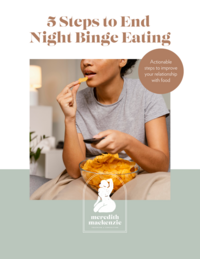

When people talk about emotional eating, they often focus on stress or sadness. But the real root of emotional eating usually lies in something deeper: exhaustion. When your body is tired and stretched too thin, it sends signals that can show up as cravings. This isn’t about lack of control. It’s a sign that your body is asking for rest and comfort.
Food offers quick relief. That’s why it’s often the first thing we reach for, even when what we truly need is something else. When we begin to understand this, we start to see emotional eating not as a failure, but as a coping tool that makes sense when you’re running on empty.
Welcome. I’m Dr. Meredith MacKenzie, a binge eating therapist and intuitive eating coach. If you find yourself reaching for food when you’re tired, overwhelmed, or stretched too thin, you’re not alone, and you’re not broken. My group program, One Body To Love, offers compassionate support, practical tools, and space to explore the real root of emotional eating. If you’re ready to shift the patterns keeping you stuck in the binge-restrict cycle, come connect with me on Instagram for daily support around food freedom, rest, and self-trust.

When Exhaustion Shows Up as Cravings
Tiredness doesn’t always feel like yawning or heavy eyes. Sometimes, it shows up as intense cravings, especially for high-energy foods like sugar or carbs. These foods light up the brain’s reward system and give a fast (but short-lived) burst of energy or comfort.
When you’ve been holding it together all day, food can feel like the easiest way to soothe yourself. It’s quick. It’s familiar. It works, at least for a moment. But when you eat to push through exhaustion, the root issue doesn’t go away. You stay tired, and the pattern repeats. This is where the real root of emotional eating begins: with unmet needs, masked by cravings.
Want to understand your cravings without guilt? Read Is It Cravings or Comfort? A Gentle Way to Check In Without Shame for a simple, compassionate tool to help you tune in to what you really need.
Why We Reach for Food When We’re Tired or Overwhelmed
Most women who overeat aren’t just hungry, they’re depleted. Mentally, physically, and emotionally. You might be:
- Working long hours without enough breaks
- Caring for kids, aging parents, or everyone in between
- Managing constant decisions and emotional labor
- Holding it all together while feeling disconnected from your own needs
In these moments, your brain isn’t really looking for nutrients. It’s looking for ease. Your body is seeking comfort and relief. And food, especially quick, energy-dense food, often becomes the fastest way to get that.
- Rest may feel impossible.
- Connection might feel out of reach.
- Quiet or space could feel like a luxury you can’t afford.
But food? It’s available. It’s familiar. It gives a fast hit of “okay” even if it fades quickly. Over time, this becomes a pattern. Not because you’re doing something wrong, but because your nervous system is doing what it’s designed to do: seek safety and soothe stress.
This is the real root of emotional eating, not greed, not lack of control, but a body doing its best to feel better in the face of chronic overwhelm. Recognizing this is the first step toward shifting how you respond to those challenging moments.
Craving food when you’re exhausted? Watch Cravings, Exhaustion & Relief to learn what your body might really need.
How Burnout and Over-Functioning Reveal the Real Root of Emotional Eating
Burnout is often hidden under busy schedules and full calendars. You might be praised for how much you do, how well you perform, and how “together” you seem. But inside, you’re running on fumes. Over-functioning, doing more than your share to keep things afloat, is a common pattern for many women. It looks like skipping breaks, putting others first, and keeping your own needs low on the list.
When you’re burned out, your nervous system stays in survival mode. That makes it even harder to pause, rest, or check in. Food then becomes one of the few ways your body can find relief. Again, this points us back to the real root of emotional eating: chronic depletion.
Feel stuck in guilt after eating? Read Breaking the Shame Cycle After Emotional Eating for a compassionate path toward relief and repair.
How Shame Fuels the Emotional Eating Cycle
Shame is the silent driver behind many emotional eating patterns. You might feel ashamed for needing a break. Ashamed for eating “too much.” Ashamed for not being able to stop. This shame leads to more stress and self-judgment. It keeps you stuck in the cycle: feeling bad, eating for relief, and then feeling bad again. It adds to the exhaustion.
Shame tells you the problem is your body or your willpower. But that’s not the truth. The truth is, your body has been doing what it needs to survive and feel safe. The real root of emotional eating is not weakness; it’s the way your nervous system copes with unmet needs and constant pressure.
Struggling with comfort eating? Read Comfort Eating Explained to understand why it happens and how to gently shift the cycle.
Gentle Check-Ins: What Am I Really Craving?
A gentle way to shift this pattern is by checking in with yourself. Before reaching for food, try to pause and ask: What do I need right now? Sometimes the answer is food. But other times, it might be quiet, a break from decisions, a bit of space, or rest.
This pause isn’t about judging your choices. It’s about listening. When you get curious instead of critical, you open up space to meet your needs in a way that feels more nourishing, whether that includes food or something else. You don’t need to do it perfectly. Even noticing once in a while is a powerful start. Over time, your body begins to trust that it can be heard and cared for.
Feeling out of control with food? Watch Craving Calm to explore what bingeing might be trying to tell you.
Finding New Ways to Soothe and Rest
If food has been your go-to source of comfort, it’s for good reason. It works. But it’s not the only tool available. Rest doesn’t just mean sleep. It means taking pressure off your nervous system. That might look like:
- Saying no to one more task
- Lying down with your eyes closed for five minutes
- Asking for help
- Listening to calming music
- Taking a quiet walk
- Turning off your phone for a while
These small steps can help your body return to a state of calm without relying solely on food. Over time, they help your nervous system learn new ways to feel safe, supported, and nourished. When you respond to exhaustion with rest instead of food, emotional eating starts to lose its grip. You’re not removing comfort, you’re just expanding the ways you receive it.
Looking for a new way to cope without turning to food? Read How to Stop Using Food as a Coping Mechanism for supportive, practical guidance.
Support for Healing the Real Root of Emotional Eating
Emotional eating often begins with exhaustion, deepens with burnout, and is fueled by shame. Your cravings aren’t random; they’re signals from your body asking for care, rest, or relief.
The real root of emotional eating isn’t about food. It’s about unmet needs. When you begin to listen without judgment and respond with compassion, food no longer carries the weight of your stress. That’s where true healing begins.
If you are ready to step out of the cycle and explore what your body is really asking for, Food Freedom in a Weekend is a self-paced course that helps you pause the pattern and reconnect with rest, care, and clarity without guilt or rules.
Looking for deeper support? One-on-one coaching offers space to explore your personal triggers, soothe your nervous system, and build lasting tools that feel good in your body and your life.
Not sure where to begin? You can listen to my podcast or visit my YouTube channel for practical tools and gentle guidance. Or book a free call, and we can find the kind of support that feels right for you.